
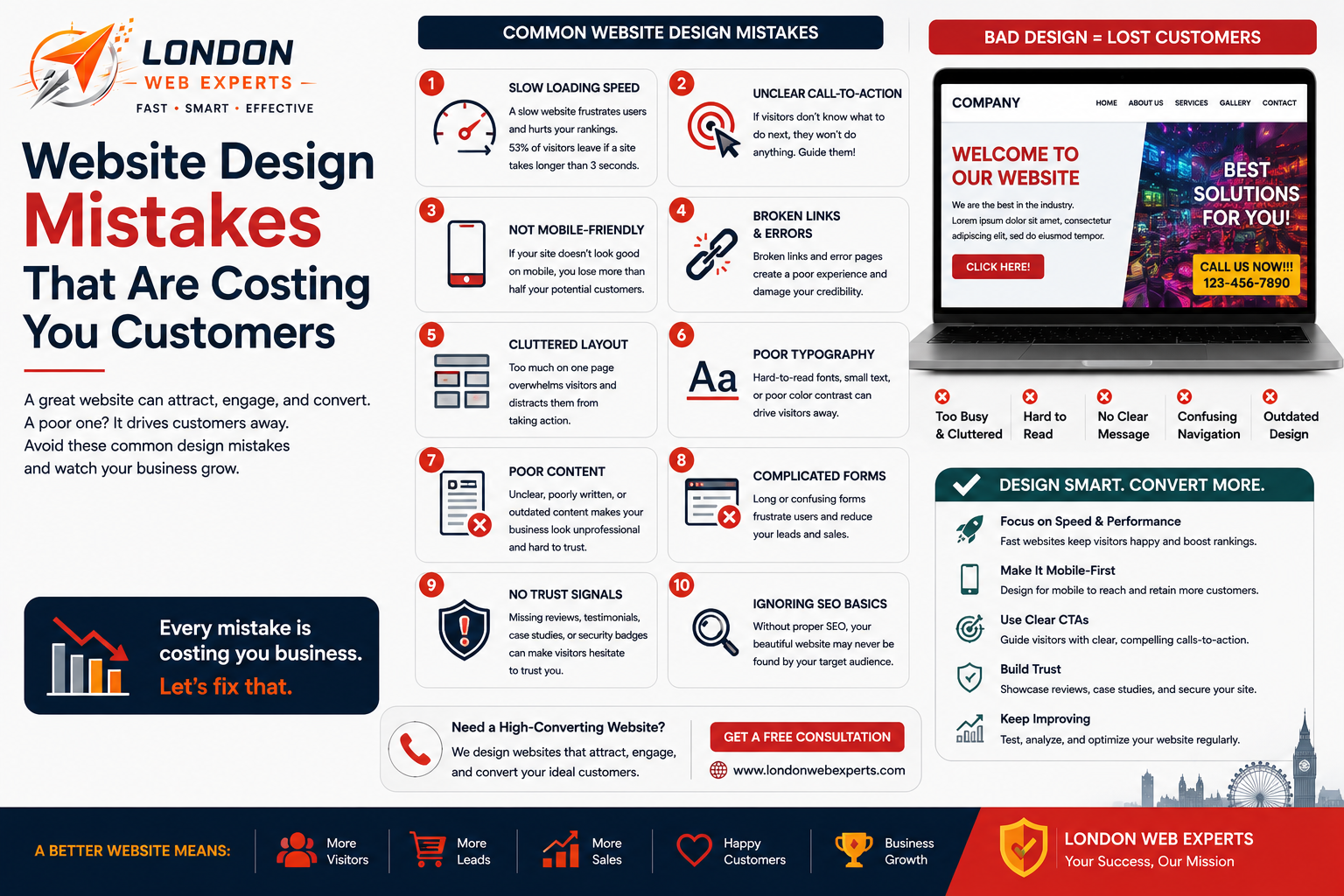
Website Design Mistakes That Are Costing You Customers
Your website is one of the most valuable marketing tools your business owns. It works around the clock to attract visitors, build trust, generate inquiries, and convert potential customers into paying clients. However, even small Website Design mistakes can reduce your credibility and cause visitors to leave without taking action.
Many businesses invest in advertising to bring people to their websites but overlook the user experience after visitors arrive. Poor navigation, slow loading pages, confusing layouts, and outdated designs often result in lost opportunities. By identifying and fixing these common issues, you can improve customer satisfaction, increase conversions, and strengthen your online presence.
Website Design mistakes such as slow loading pages, poor mobile responsiveness, confusing navigation, weak calls to action, and outdated layouts can reduce customer trust and lower conversion rates. Fixing these issues helps improve user experience, SEO performance, and overall business growth.
Why Website Design Matters
A professionally designed website does much more than look attractive. It helps visitors find information quickly, encourages them to stay longer, and guides them toward making an enquiry or purchase. When users enjoy their experience, they are more likely to trust your business and recommend it to others.
A well-planned Website Design also supports search engine optimization by improving page structure, website speed, and user engagement. Businesses that invest in quality web design often experience higher rankings and better conversion rates.
If you want to improve your website, explore our professional web design services.
Good website design helps
- Build customer trust
- Improve SEO
- Increase enquiries
- Boost conversions
- Improve user experience
- Support business growth
Slow Website Speed
One of the biggest reasons visitors leave a website is slow loading speed. Users expect pages to load quickly, and even a short delay can increase bounce rates and reduce sales. A fast Website Design keeps visitors engaged while improving search engine rankings. Compressing images, reducing unnecessary code, and choosing reliable hosting are simple ways to improve website performance.
Google recommends improving page speed to deliver a better user experience. Use this URL: https://pagespeed.web.dev/
Ways to improve speed
- Compress images
- Reduce unnecessary scripts
- Enable browser caching
- Minify CSS and JavaScript
- Use reliable hosting
- Optimize page loading
Poor Mobile Experience
Most people now browse websites using smartphones. If your website does not display correctly on mobile devices, visitors are unlikely to stay for long. A responsive Website Design automatically adjusts to different screen sizes, making navigation simple and improving readability across all devices. Google also uses mobile-first indexing, making mobile optimization essential for both SEO and customer experience.
Mobile optimization includes
- Responsive layouts
- Easy navigation
- Fast-loading pages
- Readable text
- Click-friendly buttons
- Mobile-friendly forms
Confusing Navigation
Visitors should be able to find important information within a few seconds. Complex menus, broken links, or poorly organized pages often frustrate users and increase bounce rates. An effective Website Design uses simple navigation with clearly labeled menus and logical page structures that guide visitors naturally through the website. Clear navigation helps customers complete inquiries, purchases, or bookings more quickly.
Improve navigation by
- Simplifying menus
- Organising pages logically
- Adding clear headings
- Using internal links
- Highlighting contact information
- Reducing unnecessary clicks
Weak Calls to Action
A website should always encourage visitors to take the next step. Without clear calls to action, many users leave without contacting your business or completing a purchase. Good Website Design places action buttons where they are easy to find and uses simple language that motivates visitors to act. Whether you want customers to request a quote or buy a product, every page should include a clear purpose.
Effective calls to action include
- Contact Us
- Request a Quote
- Book a Consultation
- Buy Now
- Get Started
- Learn More
Outdated Website Design
An outdated website can damage your credibility even if your products or services are excellent. Visitors often judge a business based on its online appearance before making contact. Refreshing your Website Design with modern layouts, high-quality images, and updated branding creates a stronger first impression and encourages visitors to stay longer. A redesign also provides an opportunity to improve SEO and website performance.
Signs your website needs updating
- Old visual design
- Broken pages
- Slow performance
- Poor mobile experience
- Outdated content
- Difficult navigation
Difficult-to-Read Content
Website content should be clear, easy to read, and well organized. Long paragraphs, small fonts, and poor color contrast make it difficult for visitors to find the information they need. A professional Website Design improves readability by using appropriate spacing, headings, bullet points, and simple language. Well-structured content also helps search engines understand your pages more effectively.
Improve readability by
- Using short paragraphs
- Adding headings
- Including bullet points
- Choosing readable fonts
- Increasing white space
- Using simple language
Ignoring SEO Best Practices
A beautiful website cannot generate results if customers cannot find it. SEO should be considered during the design process rather than after the website has been completed. A well-optimized Website Design includes proper heading structure, optimized images, internal linking, fast-loading pages, and helpful content. Businesses that combine strong SEO with quality web design are more likely to attract qualified traffic and increase conversions.
You can also learn more about our SEO and website optimization services.
Google provides detailed guidance on creating helpful websites through Search Central. Use this url: https://developers.google.com/search
SEO best practices include
- Optimized headings
- Image optimization
- Internal linking
- Fast page speed
- Helpful content
- Mobile responsiveness
Poor Quality Images
Images play an important role in creating a professional first impression. Blurry photos, outdated graphics, or inconsistent branding can make your business appear less trustworthy. High-quality visuals help visitors understand your products or services and encourage them to stay on your website longer. A professional Website Design uses optimized, high-resolution images that load quickly without affecting website performance. Every image should support your content and strengthen your brand identity.
Improve your website images by
- Using high-resolution photos
- Compressing images for faster loading
- Keeping branding consistent
- Adding descriptive alt text
- Using original business photos
- Updating outdated visuals
Missing Trust Signals
Visitors are more likely to contact or buy from businesses they trust. If your website does not include trust signals, potential customers may hesitate before taking action. Adding customer testimonials, reviews, certifications, secure payment badges, and clear contact details helps reassure visitors that your business is genuine and reliable. Trust signals also improve your brand reputation and encourage higher conversion rates.
Important trust signals include the following:
- Customer reviews
- Client testimonials
- SSL security certificate
- Industry certifications
- Business contact details
- Case studies
Too Many Pop-ups
Pop-ups can be useful for promoting offers or collecting email addresses, but using too many can frustrate visitors and interrupt their browsing experience. Large pop-ups that appear immediately after a page loads often increase bounce rates. A good Website Design uses pop-ups carefully and only when they add value. They should be easy to close, mobile-friendly, and displayed at the right time.
Best practices for pop-ups
- Show them at the right time
- Keep them easy to close
- Avoid multiple pop-ups
- Make them mobile-friendly
- Offer genuine value
- Limit their frequency
Not Tracking Website Performance
Many businesses launch a website and never measure its performance. Without tracking visitor behavior, it becomes difficult to understand what is working and what needs improvement. Monitoring analytics helps identify popular pages, traffic sources, and conversion rates. This information allows you to improve your Website Design based on real customer behavior rather than guesswork.
Google Analytics provides valuable insights that support better marketing decisions. Use this URL: https://analytics.google.com/
Track important metrics such as
- Website visitors
- Traffic sources
- Bounce rate
- Conversion rate
- Popular pages
- Customer behaviour
Failing to Update Your Website Regularly
A website should never remain unchanged for years. Outdated content, expired promotions, broken links, and old information reduce customer confidence and may affect your search rankings. Regular updates show both visitors and search engines that your website is active. Publishing new blog articles, refreshing service pages, and updating business information helps maintain a professional online presence. Keeping your website current also improves security and overall performance.
Regular updates should include
- New blog posts
- Updated service pages
- Fresh images
- Current contact details
- Plugin and software updates
- Security improvements
Benefits of Fixing Website Design Mistakes
Correcting common Website Design mistakes can have a significant impact on your business. Even small improvements often increase customer engagement, improve SEO performance, and generate more inquiries. A website that is fast, mobile-friendly, easy to navigate, and visually appealing creates a better experience for visitors while supporting long-term business growth.
You can also explore our recent website projects to see how professional design improves business performance.
Internal Link:
https://londonwebexperts.co.uk/portfolio/
Key benefits include
- Better user experience
- Higher search rankings
- More customer enquiries
- Increased conversion rates
- Stronger brand credibility
- Long-term business growth
Ready to Improve Your Website?
If your website is losing visitors because of outdated design, slow performance, or poor user experience, now is the perfect time to make improvements. A professional Website Design helps build trust, improve SEO, and convert more visitors into loyal customers. At London Web Experts, we create fast, mobile-friendly, SEO-optimized websites that help businesses grow online. Whether you need a complete website redesign or improvements to your existing site, our experienced team is ready to help.
Learn more about our services on our homepage or contact us today for a free consultation.
FAQ Section
What are the most common Website Design mistakes?
Some of the most common mistakes include slow loading pages, poor mobile responsiveness, confusing navigation, weak calls to action, outdated layouts, and ignoring SEO best practices.
Can poor Website Design affect Google rankings?
Yes. Website speed, mobile usability, page structure, and user experience are all factors that can influence search engine performance.
How often should I redesign my website?
Most businesses should review their website every two to three years. Regular updates help keep the design modern, improve security, and support changing customer expectations.
Why is mobile-friendly design important?
A responsive website provides a better experience for mobile users and supports Google’s mobile-first indexing, helping improve both SEO and customer satisfaction.
Does improving Website Design increase sales?
Yes. A better website experience builds trust, keeps visitors engaged, and encourages more inquiries, purchases, and conversions.
How can I tell if my website needs improvement?
Signs include high bounce rates, slow loading pages, outdated visuals, declining inquiries, poor mobile performance, and low search engine rankings.
Conclusion
A successful website is more than an attractive design—it is a powerful tool that supports your marketing, builds customer trust, and drives business growth. By identifying and fixing common Website Design mistakes such as slow page speed, poor navigation, weak calls to action, outdated content, and missing trust signals, you create a better experience for every visitor.
Investing in continuous website improvements helps increase search visibility, generate more qualified leads, and improve conversion rates. With a modern, SEO-friendly, and user-focused website, your business will be better positioned to attract customers, outperform competitors, and achieve long-term online success.